Bulk fermentation is the first fermentation period of the mixed dough before dividing or shaping. Keep track of time, but use the selected recipe’s dough cues and temperature assumptions to decide when to move on.
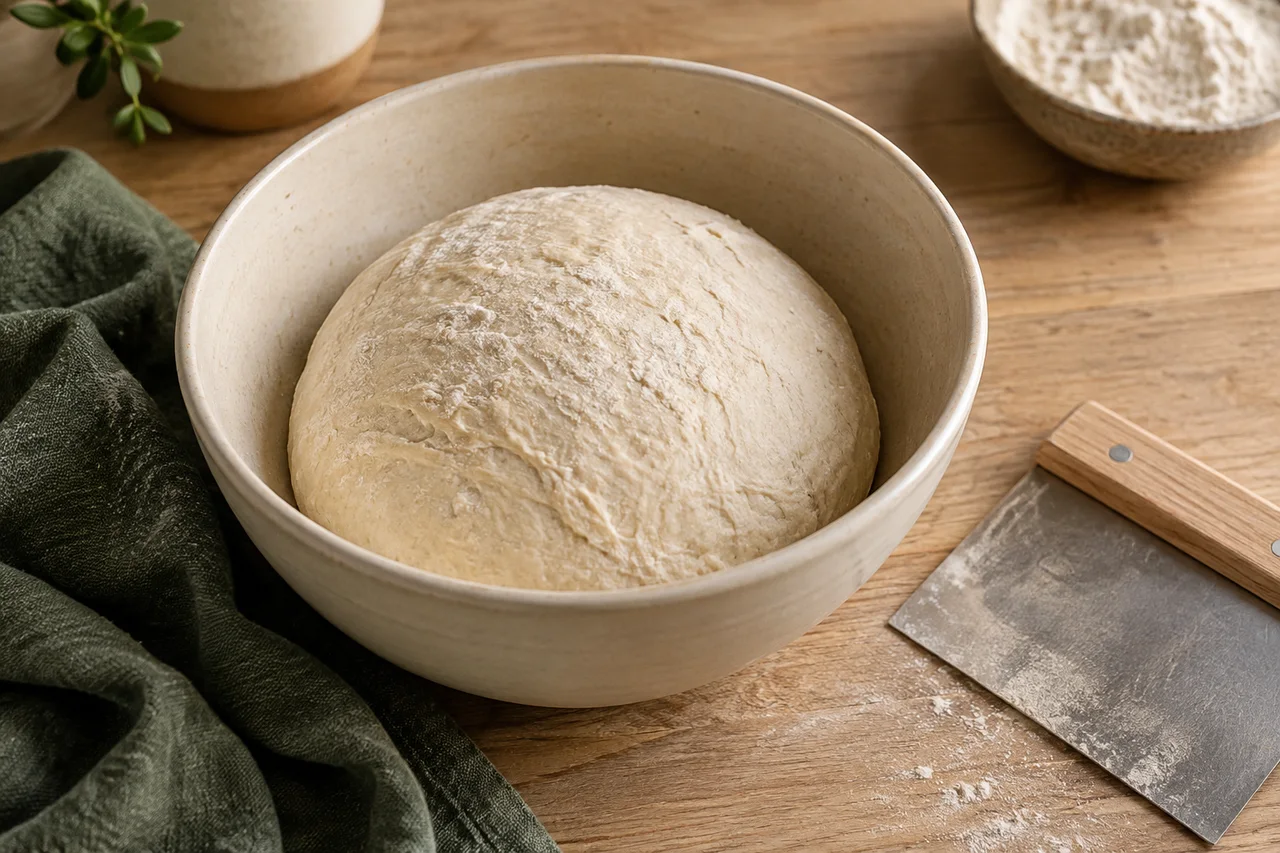
Separate the two rising stages
Bulk is not another name for the entire waiting period until baking. Shaping divides it from the final proof. When a recipe includes folds during bulk, those folds are part of that period; they do not automatically restart the fermentation clock.
Keep both stages visible in your notes. “Six hours of rising” is ambiguous; “four hours in bulk, then two hours after shaping” identifies the actual sequence.
Record a pattern, not one magic sign
Note the dough’s starting level, expansion, surface appearance, and feel during handling. Compare those observations with your recipe. The Perfect Loaf’s proofing reference explains the consequences of too little or too much fermentation; its guidance should be read in context rather than reduced to a single photo rule.
A straight-sided container makes a height change easier to record. Use your own starting mark. A domed bowl does not translate a height increase into the same percentage volume increase.
Why the same time can produce a different result
Temperature, formula, and starter condition change the pace. The Perfect Loaf’s summer-baking guide describes adapting the process to warmer conditions. The practical implication is simple: write down the conditions beside the time.
For a cooler or warmer day, do not automatically add or subtract a fixed number of hours. Observe more closely and keep the recipe’s target in view. A refrigerator also does not instantly bring the center of a warm dough to refrigerator temperature.
A useful observation log
| Moment | Write down |
|---|---|
| After mixing | Time, ingredient weights, measured temperature if available, initial level |
| During development | Fold times and changes in strength |
| Before shaping | Expansion and dough behavior relative to the recipe |
| Before baking | Final-proof conditions and observations |
This is a documentation framework, not a fermentation schedule. For dough that becomes difficult to handle, see sticky sourdough troubleshooting.
Sources & scope
- King Arthur Baking: how to tell if dough has risen enough
- The Perfect Loaf: adapting sourdough to summer temperatures
Source-based explanation and editorial checklists by SourdoughStart, operated by Tag Ad Limited. AI-assisted article revised 2026-10-12. Source links are not endorsements.
Revision note: prepared for the new reference-led edition. Suggest a correction.