Baking guides
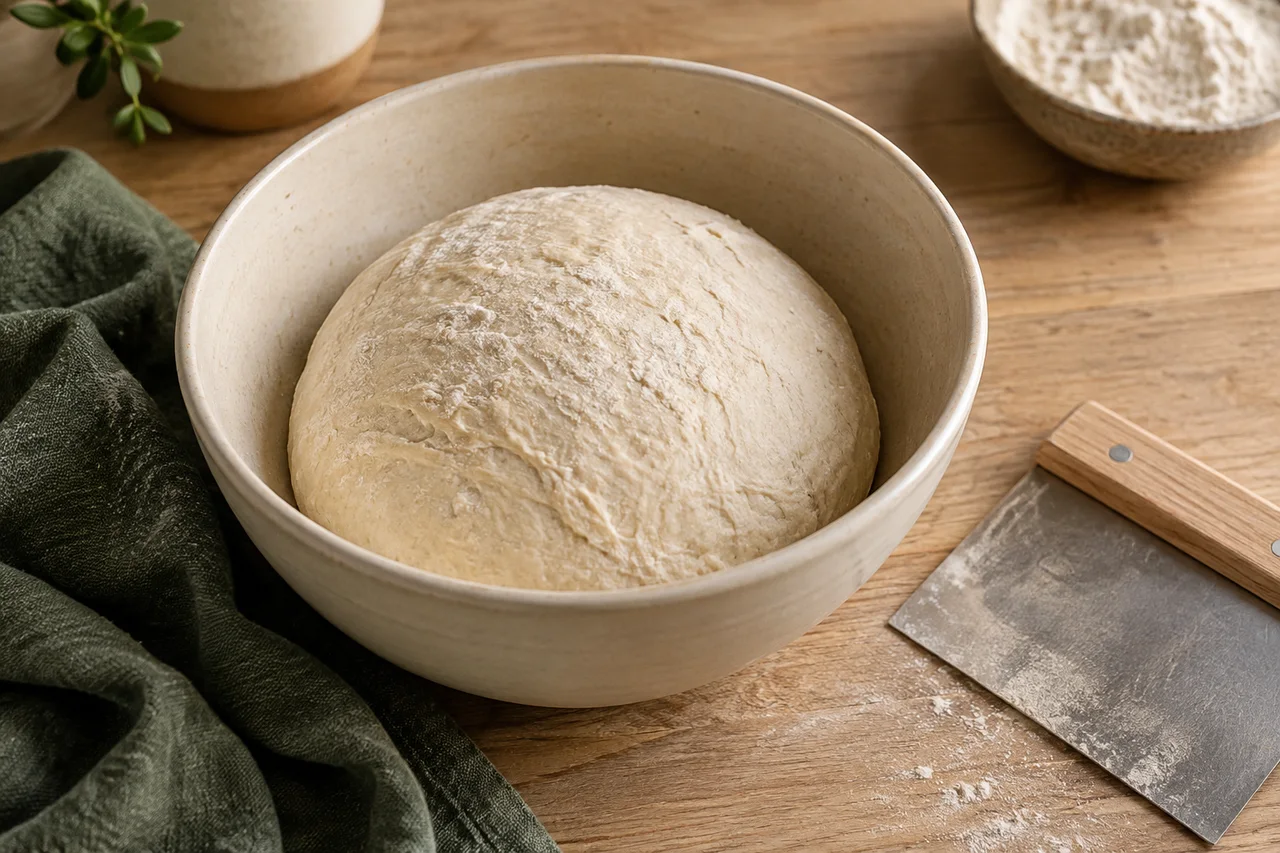
Bulk fermentation: watch the dough, keep the clock
Know where bulk begins and ends, which observations to record, and why a universal time table cannot judge readiness.
Read the guide ↗THE SOURDOUGH REFERENCE
A practical foundation for planning, fermentation, and flour-and-water arithmetic.
Baking guides
Know where bulk begins and ends, which observations to record, and why a universal time table cannot judge readiness.
Read the guide ↗Baking guides
See the flour-and-water arithmetic and calculate total hydration without hiding the assumptions.
Read the guide ↗Baking guides
Understand the purpose of a rest before adding one to your recipe.
Read the guide ↗Baking guides
A mixing checklist that does not invent a new recipe.
Read the guide ↗Baking guides
Build a supported shape, then give expansion a place to go.
Read the guide ↗Baking guides
Use expansion, feel and the recipe together; do not ask one poke to decide everything.
Read the guide ↗Baking guides
A repeatable way to interpret faster and slower fermentation.
Read the guide ↗Baking guides
Keep the early crust flexible without improvising around hot glass, metal or heating elements.
Read the guide ↗Baking guides
Match the temperature and bake stages to the loaf and equipment.
Read the guide ↗Baking guides
Compare grain, extraction and the formula before comparing brand claims.
Read the guide ↗Baking guides
A same-day schedule requires a suitable recipe and an already-established starter.
Read the guide ↗Baking guides
Sourness reflects interacting ingredients and fermentation choices.
Read the guide ↗Baking guides
Temperature is one input, not a complete fermentation model.
Read the guide ↗Baking guides
Plan availability around a complete recipe instead of an exact predicted finish.
Read the guide ↗